Understanding How UPI Works
Have you ever wondered what happens when you pay for your Java Chip(with extra frappucino) at Starbucks using UPI (Unified Payment Interface)?
From the moment you tap pay on GPay and transfer ₹ $390 ($4.63) from your bank account to theirs, a lot is happening behind the scenes. While it feels effortless on your end, as you tap buttons and enter your pin, a complex process of peer-to-peer transmission and technical coordination ensures the transaction is successful.
In this article, we’ll dive deep into how UPI works under the hood, covering everything from its architecture to the intricate mechanisms that make it seamless. So, sit back, relax, and let’s unravel the magic behind UPI!
How UPI Works?
UPI offers 2 varieties of transactions i.e. P2P and P2M ~ Peer-to-Peer and Peer-to-Merchant
As soon as a new real-world transaction is initiated a 4 party model comes into play popularly known as:
- Payer — The person who is initiating the payment or started the payment for a service or a product.
- Payee — The person who receives the payment into their account.
- Beneficiary Bank — Involvement of the receiver’s bank account
- Remitter Bank — Involvement of Payer’s Bank and attached account
The money got debited from the payee’s account and was inserted into the merchant’s bank. This is known by almost everyone. Let's go to deeper aspects of how this UPI really works
How Does UPI Really Work?
In the early days, UPI was not at the boom, businesses that wanted to accept payments and sell their services to customers had to rely on trusted third-party payment gateways like Razorpay or similar providers. However, a significant challenge with using these platforms was the platform fees they charged, excluding the additional 18% GST, as outlined on Razorpay’s official website.
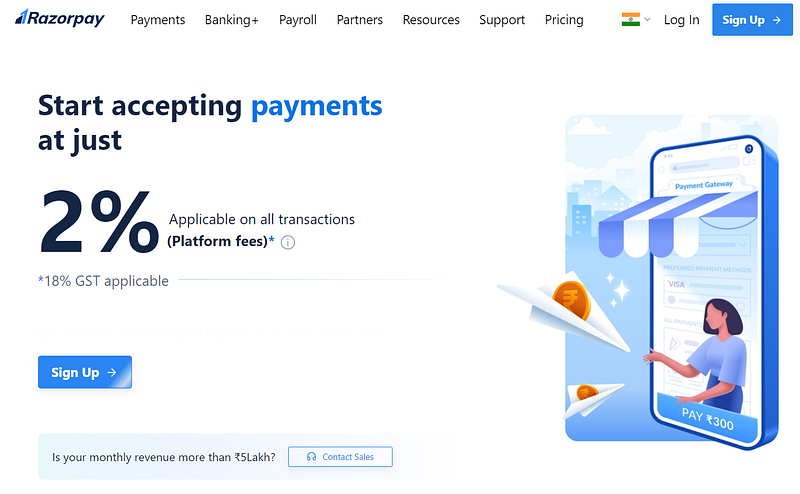
So let's say someone needs to transfer an amount of 1lakh
To address these challenges, UPI was introduced with the ZERO MDR (Merchant Discount Rate) policy. This policy eliminated processing fees for transactions, allowing businesses to accept payments without incurring additional costs which include the 2% + 18% GST.
So the concept that UPI introduced as the VPA(virtual payment address) is like proof for your payment which helps in eliminating the manual entry of your bank account number, IFSC number, or other sensitive details. This can be created through UPI apps, linking users to their bank accounts, and merchants can easily accept payments by simply providing their VPA.
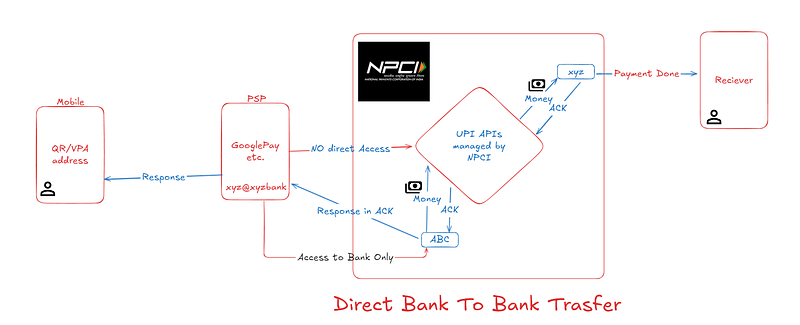
Note: UPI apps never directly access the UPI APIs. Instead, they communicate with the PSPs or banks, which handle the transaction process by securely interacting with the UPI system. This ensures a robust and secure transaction environment, with strict oversight and adherence to NPCI guidelines.
The sender’s bank (or PSP) validates the payment request by checking:
- Whether the sender’s account is active and has sufficient balance.
- Whether the UPI PIN provided by the user is correct (via encrypted transmission).
- Once validated, the sender's bank forwards the transaction request to the NPCI (National Payments Corporation of India) through the UPI network.
- NPCI acts as a clearinghouse to manage communication between the sender's and recipient's banks.
The National Payments Corporation of India (NPCI), which operates UPI, oversees these transactions with support from the government to ensure compliance, security, and reliability in digital payments.
The receiver’s bank
- So after all the validation checks NPCI finally routes the payment details to the receiver’s bank.
- This check includes the validation of the recipient’s bank details and the ready-to-accept the funds.
- After this confirmation also gets validated by the banks then only the money gets debited from the sender and gets credited to the receiver
After all this Acknowledgement with the confirmation
- NPCI sends a confirmation of the transaction to both the sender’s and recipient’s banks.
- The sender’s bank notifies the UPI app, which displays the transaction status (success or failure) to the sender
The transaction Logs and Reporting get logged into the
- Sender’s bank for debiting.
- Recipient’s bank for credit.
- NPCI for transaction oversight and future reconciliation and also they can use them for secure concerns.
- Both banks update their transaction histories, which users can access via their UPI app or bank statements in the form of bank balance forms.
If the transaction fails at any step (e.g., insufficient funds, or TEcserver issues), the sender is notified with a failure message.
UPI uses robust error codes (e.g.,TXN_FAILURE,INSUFFICIENT_BALANCE) to indicate the cause of failure, ensuring transparency.
To be specific this entire process typically takes a few seconds, demonstrating the efficiency of UPI.
Why Zero MDR Policy?
The Government of India introduced the Zero MDR Policy to promote transparency and encourage cashless transactions across the country. This policy ensures that digital payments, such as bank-to-bank transfers via UPI and RuPay, incur no transaction fees for merchants or users. However, this comes at a financial cost to NPCI and banks, as they bear the operational expenses. While the service remains free, it is advisable to make the most of it and embrace digital payment methods.