How I Would Plan to Ace C++ Coding Interviews: Tips and Common Problems
C++ is a powerful and most demanding language, throughout the globe and it known for it’s efficiency, control over hardware, and versatility. It is also popular language during the interview rounds its core concepts identifies the person’s ability to understanding the computer architecture.

Cracking a Interview is about knowing more than the interviewer
However, passing C++ coding interviews requires more than just bookish knowledge of the language. Here’s my approach to acing the C++ problems to prepare for. I consider you must have around 5–6 months before interviews.
You can also this article for free here also if you are not an member. Or you are a Member continue reading.
My Approach to Acing C++ Coding Interviews
1. Master C++ Fundamentals
Before diving into the more advanced concepts and coding problems, it is essential for us to go through basics and get a grip over the fundamentals
- Syntax: Understanding the syntax and the structure of the C++ programs are crucial as it stands base for each logic we are going to study further.
- Data structures and algorithms: I would have given around 2–3 months to master it concepts such as Data structures: Linked List, Arrays, Maps etc. Algorithms like Searching, Sorting, Finding Shortest path(Dijkstra’s)
- Object-oriented programming: The most debatable programming concepts oops in which classes are used to do the concepts like Inheritance encapsulations, and polymorphism etc.
- Memory management: As C++ provides control over memory, referencing and using it properly is always far most difficult to conquer.
- Pointers: Pointers are the variables which generally stores the memory address of an another variable. They enable programs to simulate call-by-reference as well as to create and manipulate dynamic data structures.
- Templates: It stands for the Standard Template Library(STL) which is a set of template classes and functions which also provides the implementations of common data structures and algorithms.
2. Focus on Data Structures and Algorithms (DSA)
Mostly the backbone of any coding interviews are our most important Data structures and algorithms. If you want a complete roadmap this is discussed in upcoming sections. I plan to focus on the following topics:
- Arrays and Strings: Practice problems on sorting, searching, and working with the common array manipulations.
- Linked List: Understanding singly and doubly linked list and the actual connections of node as they acts as the backbone of big complex data structures like Tree, BGT etc.
- Stacks and Queues: Mastering these data structures is crucial as they make the foundations of more complex theories like DFS and BFS in recursions and backtracking.
- Trees and Graphs: Problems involving binary trees, binary search trees, and graph traversals techniques such as BFS, DFS, Double BFS and DFS.
- Hashing: Knowing how to use hash maps and hash sets for efficient lookups is a valuable skill as they are like gems for the time complexity reductions as the searching time in them is always O(1).
- Dynamic Programming (DP): DP is one of the trickiest and yet very interesting concepts in DSA. They are generally used to optimize the current algorithm you applied.
- Greedy Algorithm: These are also the algorithm which are useful for optimization problems, where we become greedy towards something of local problem and consider that our final result is going to be ok.
Trust me bro, this are the names which seems to be very dangerous but as you start doing the problems on it you will see that your grasping power with problem solving skills differ before and after.
3. Practice Coding Problems
It is not enough to just read about data structures and algorithms. Practice is the key to performing well and in coding interviews as there is no google or chatGPT thing going to tell you about the optimal solutions or to use Dijkstra’s to solve any problems. You need to come to the field to be a king. My best preferences in this 4 to 5 months my only goal is to do leetcode problems, i am not saying blindly i solved more than 200+ problems on leetcode in past 4 to 5 months and these are my results.
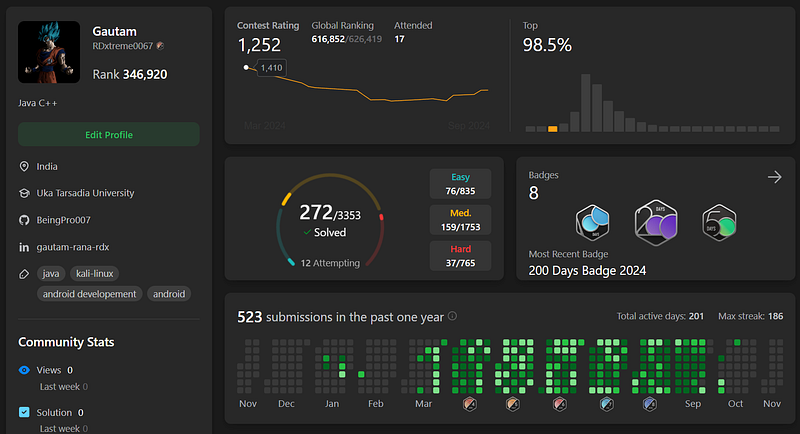
That’s not much but i stayed consistent for around 170+ days i guess. This how i plan to tackle the most difficult part of this journey(DSA):
- Focus on different difficulty levels: I’ll start with easy problems to get a grip on the basics and gradually progress to medium and hard problems to challenge myself. From the above figure you can see that my maximum submissions are just medium and easy one.
- Time-bound practice: I am not big supporter to it but this is must if we want to crack the interviews so i am also working on it and Leetcode have inbuilt feature in it.
4. Learn to Write Clean, Optimized Code
Interviewers generally tell you to write clean and optimized code as
Sword is not required to cut the vegetables
So always write as much as code required for example.
A. Big Fluffy code:
#include <iostream>
using namespace std;

int main() {
    int a, b;
    cout << "Enter first number: ";
    cin >> a;
    cout << "Enter second number: ";
    cin >> b;

    if (a > b) {
        cout << "The maximum number is: " << a << endl;
    } else if (b > a) {
        cout << "The maximum number is: " << b << endl;
    } else {
        cout << "Both numbers are equal." << endl;
    }

    return 0;
}
B. Optimized code with ternary operator usage:
#include <iostream>
using namespace std;

int main() {
    int a, b;
    cin >> a >> b;
    cout << "Maximum: " << (a > b ? a : (b > a ? b : "Equal")) << endl;
    return 0;
}
Interviewer will se the differences that the person have the knowledge to express things in better way.
5. Take Part In Contests
Contests are the foremost and plays a huge role as you are in the time bound environment where we are given various problems and we need to solve them in time bound conditions. And based on this your ranking is defined
For this thing Leetcode is not so good but you need to transfer to codeforces which is best for the contests.
6. Review Past Mistakes
Apart from just learning things you must learn from the mistakes which every millionare or a successful persons do. If i were in your place then i will revisits the problems which i haven’t able to tackle during interviews. This includes revisiting my solution to improve its efficiency or rewriting it in a cleaner way.
Roadmap to Ace C++ Coding Interviews
Here’s my C++ coding Journey which i follow solely to achieve this
Phase 1: Strengthen Core C++ Skills
Timeline: 2–3 Weeks
1. Master C++ Fundamentals:
- Data types, variables, operators, loops, and conditionals.
- Functions, function overloading, inline functions.
- Pointers and memory management (
new,delete). - Input/Output using
cin,cout, and file handling.
2. Advanced C++ Concepts:
- OOPs: Classes, objects, inheritance, polymorphism, encapsulation, and abstraction.
Master STLs which are being used frequently as containers and algorithms
vector,set,map,unordered_map,queue,priority_queue.- Functions:
sort(),binary_search(),lower_bound(),upper_bound().
Dynamic Memory Allocation:
- Learn
malloc,calloc, and smart pointers (std::shared_ptr,std::unique_ptr). - Lambda functions, function pointers, and templates.
3. Practice Basic Problems:
- Implement them in the problems to get a strong grip over syntax
- Examples: Prime number check, factorial, Fibbonacci etc.
Phase 2: Master DSA Concepts
Timeline: 3–4 Months
A. Arrays and Strings (2–3 Weeks)
Topics:
- Two-pointer technique, sliding window.
- Prefix sum, kadane’s algorithm (max subarray sum).Kadane’s algorithm is the most important of this all as it is the base of the logic creations
- Array rotation and searching (binary search, linear search).
- String matching algorithms (Rabin-Karp, KMP).
Problems:
- Easy: Two-sum, Reverse a String.
- Medium: Longest Substring Without Repeating Characters.
- Hard: Median of Two Sorted Arrays.
B. Linked Lists (1–2 Weeks)
Topics:
- Singly, doubly, and circular linked lists.
- Operations: Insertion, deletion, reversal.
- Cycle detection (
Floyd’s cycle detection). - Merge two sorted lists.
Problems:
- Easy: Merge Two Sorted Lists.
- Medium: Remove Nth Node From End of List.
- Hard: Reverse Nodes in k-Group.
C. Stacks and Queues (1–2 Weeks)
Topics:
- Implementation using arrays and linked lists.
- Balanced parentheses.
- Monotonic stack/queue.
- Implement queue using stacks and vice-versa.
- Sliding Window Maximum.
Problems:
- Easy: Valid Parentheses.
- Medium: Implement Min Stack.
- Hard: Largest Rectangle in Histogram
D. Trees and Graphs (4–5 Weeks)
Trees:
- Binary trees, binary search trees.
- Tree traversals (Inorder, Preorder, Postorder, Level Order).
- Lowest Common Ancestor, Diameter of a Tree.
- Segment trees, Fenwick trees.
Graphs:
- Representation (Adjacency Matrix, List).
- BFS, DFS, Dijkstra’s, Bellman-Ford.
- Minimum Spanning Tree (Prim’s, Kruskal’s).
Problems:
- Easy: Symmetric Tree.
- Medium: Word Ladder.
- Hard: Longest Increasing Path in a Matrix.
E. Sorting and Searching (2 Weeks)
- Sorting Algorithms: Merge Sort, Quick Sort, Counting Sort, Bucket Sort.
- Searching: Binary search, exponential search, ternary search.
- Applications of Sorting:
- Find Kth smallest/largest element.
- Minimum difference between elements.
F. Dynamic Programming (6 Weeks)
Topics:
- Memoization and Tabulation.
- Subset Sum, 0/1 Knapsack.
- Longest Increasing Subsequence.
- Matrix Chain Multiplication.
Problems:
- Easy: Climbing Stairs.
- Medium: Longest Palindromic Subsequence.
- Hard: Edit Distance.
Phase 3: Problem-Solving and Competitive Coding
Timeline: Ongoing
A. Platfoms to Practice: As i told you to use leetcode you must need to use this following things also:-
- LeetCode: Focus on
EasyandMediuminitially. - GeeksforGeeks: For theory and company-specific questions.
- Codeforces: To improve problem-solving speed and rank up on there contents and show your presence.
B. Solve Questions Based on Patterns: You must need to solve the question based on pattern base like this as follows:-
- Array: Sliding window, prefix sum.
- Recursion + Backtracking: N-Queens, Sudoku Solver.
- Trees and Graphs: BFS, DFS, and graph traversals.
- DP: Subproblems and overlapping substructure.
C. Company-Specific Questions:
Based on your target companies like MAANG or any other comapanies practice question companies like Google asks most difficult questions, wheras meta asks probability based questions.
Common C++ Coding Problems to Prepare For
Here are some of the most common C++ coding problems that I plan to focus on:
1. Reverse a Linked List
- A fundamental problem involving linked lists that tests understanding of pointers and memory manipulation. This generally asked as starter.
2. Find the Missing Number in an Array
- This problem tests the ability to work with arrays and efficiently find missing elements.
3. Dynamic Programming Problems (Knapsack, Longest Common Subsequence)
- A typical problem that evaluates problem-solving and optimization skills.
4. Graph Traversal (BFS, DFS)
- Common problems require the use of graph traversal techniques to solve. This is the most important as it stand a base for recursions, backtracking etc.
5. Sorting Algorithms (QuickSort, MergeSort)
- Understanding and implementing sorting algorithms is essential in coding interviews. Sorting are generally neglected by the people but the codebase asked very frequently by accenture and big MNC.
6. Find the Duplicate Number
- Another array-related problem that tests both hashing and sorting techniques.
7. The N-Queens Problem
- A classic backtracking problem that assesses algorithmic thinking. This identifies your DFS & BFS basics
Tips for Success
A) Consistency is Key:
- Solve at least 3 problems daily (mix of easy, medium, hard).
- Revise weekly to avoid forgetting concepts.
B) Debugging and Optimization:
- Use debugging tools like GDB.
- Focus on writing clean and optimal code.
C) Communication Skills:
- Explain your thought process clearly during mock interviews.
Conclusion
Acing C++ coding interviews is a combination of mastering the language, practicing coding problems, learning algorithms, and improving the ability to communicate effectively during interviews. My approach revolves around a structured roadmap, steady practice, and review of past mistakes. By staying consistent, focused, and challenging myself with progressively harder problems, I am confident that I will be able to ace the C++ coding interviews and secure my desired role.
Write code like poetry — concise, elegant, and impactful. Simplicity is the ultimate sophistication!
System design is always been a debating topic between developers and same for the companies who are going to use this…medium.com
Read the Following topics also
Follow me for more interview preparations